


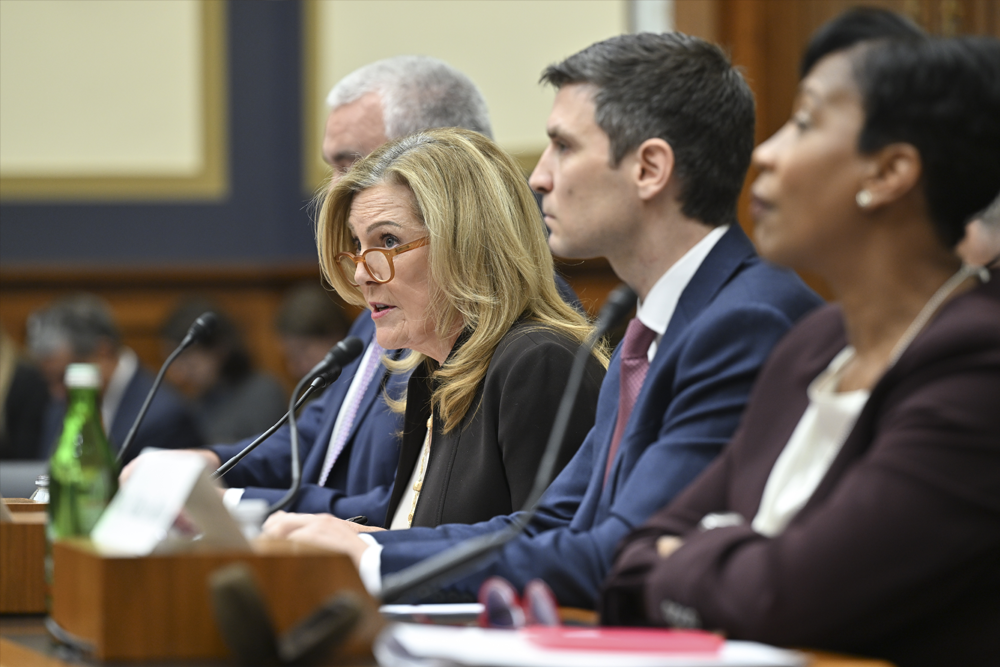
Julie Smith, Chief Administrative Officer at The Bozzuto Group, gives testimony to the House Committee on Financial Services on Dec. 3, 2025.
By Matthew Berger, SVP and Head of Policy of the National Multifamily Housing Council
The House Committee on Financial Services held a timely and important hearing today on how federal action can reduce government-driven barriers to housing production. Appearing on behalf of the National Multifamily Housing Council (NMHC), the National Apartment Association (NAA) and the Real Estate Technology & Transformation Center (RETTC), Julie Smith, Chief Administrative Officer at The Bozzuto Group and NMHC Vice Chair, outlined the headwinds facing rental housing providers and the opportunities before Congress to meaningfully increase housing supply, lower housing costs and broaden housing opportunity.
The Housing Imperative
Communities nationwide are experiencing a persistent and growing housing shortage. During the hearing, Smith highlighted several indicators of the pressures facing both residents and housing providers. A lack of supply, rising development and operating costs, high interest rates and regulatory challenges continue to push housing further out of reach for many Americans. Research has found that regulations account for 40.6% of multifamily development costs, a level that makes new construction all but impossible to undertake at attainable price points. Without action that makes housing production more feasible, cost pressures will continue to fall on families and individuals who already face serious affordability challenges.
Barriers to New Housing
In her testimony, Smith underscored the impact of intersecting regulatory and economic hurdles that make it difficult to build and operate rental housing. Zoning restrictions, slow permitting processes, duplicative requirements and local opposition continue to suppress new supply. When combined with elevated construction, labor and financing costs, these barriers significantly limit production.
Smith urged Congress to support federal incentives that encourage states and localities to adopt policies that promote housing development, such as streamlined approvals, more flexible zoning frameworks, and thoughtful approaches to increasing density and building near transit. She also reiterated longstanding concerns about rent control policies, which decades of research has consistently shown to reduce supply, discourage investment and create fewer options for residents.
Technology Can Expand Opportunity, But Requires a Federal Standard
Emerging technologies, including AI-enabled leasing, enhanced screening tools, predictive maintenance and new construction solutions, are helping housing providers operate more efficiently and improve the resident experience. These innovations support efforts to address affordability and meet growing demand.
Smith emphasized that the growing patchwork of inconsistent AI and privacy rules at the state level creates confusion and raises costs and urged Congress to consider a balanced federal standard that supports innovation, maintains strong consumer protections and reduces regulatory fragmentation.
Access to Capital Remains Essential
Smith’s testimony highlighted the need to maintain stable access to capital across all markets and economic cycles. Any changes affecting housing finance, including the future of the government-sponsored enterprises, bank capital rules or access to FHA multifamily programs, must be evaluated carefully to avoid disruptions that could restrict liquidity or discourage investment.
Legislative Opportunities
While the challenges are significant, Smith identified a number of bipartisan opportunities for Congress to advance policies that increase housing supply and improve affordability. Key proposals include the:
- HOME Reform Act of 2025, which modernizes the program and helps jurisdictions reduce local barriers to development.
- Identifying Regulatory Barriers to Housing Supply Act, which promotes transparency around exclusionary land-use practices.
- Respect State Housing Laws Act, which clarifies federal eviction law by removing outdated CARES Act notice requirements.
- Build More Housing Near Transit Act, which supports development in high-opportunity, transit-rich areas.
- Choice in Affordable Housing Act, Rural Housing Service Reform Act, Housing Affordability Act, and other proposals that streamline federal programs, expand incentives and increase access to affordable homes.
- Continued improvements to tax policy, including the establishment of a Workforce Housing Tax Credit and enhancements to Opportunity Zones to promote the rehabilitation of existing housing.
Smith also reaffirmed the need for long-term reauthorization of the National Flood Insurance Program and the Terrorism Risk Insurance Act, both of which are critical to stabilizing insurance markets that directly affect housing affordability.
“Let’s seize the moment and take meaningful steps to ensure all Americans can have a safe and decent place to call home at a price they can afford.”
—Julie Smith
The Path Forward
NMHC, NAA and RETTC stressed that there is no single solution to the housing crisis, but Congress can take meaningful steps now to support long-term supply and affordability. A combined approach that increases production, modernizes regulations, promotes responsible technology adoption and preserves access to capital will strengthen communities and expand opportunity. We thank the Committee for its attention to these issues and look forward to working with policymakers to advance solutions that make housing more attainable in communities across the country.
About Matthew Berger
 Matthew M. Berger is SVP and Head of Policy. He is responsible for developing and managing policy strategies in support of NMHC’s strategic goals and industry initiatives. Additionally, Matthew represents the interests of the multifamily industry before Congress and federal agencies on tax issues.
Learn More About Matthew >>>