



Demand Falters, Vacancy Rises and Rents Continue to Decrease in the First Quarter
Vacancy Rates Rise Year-Over-Year
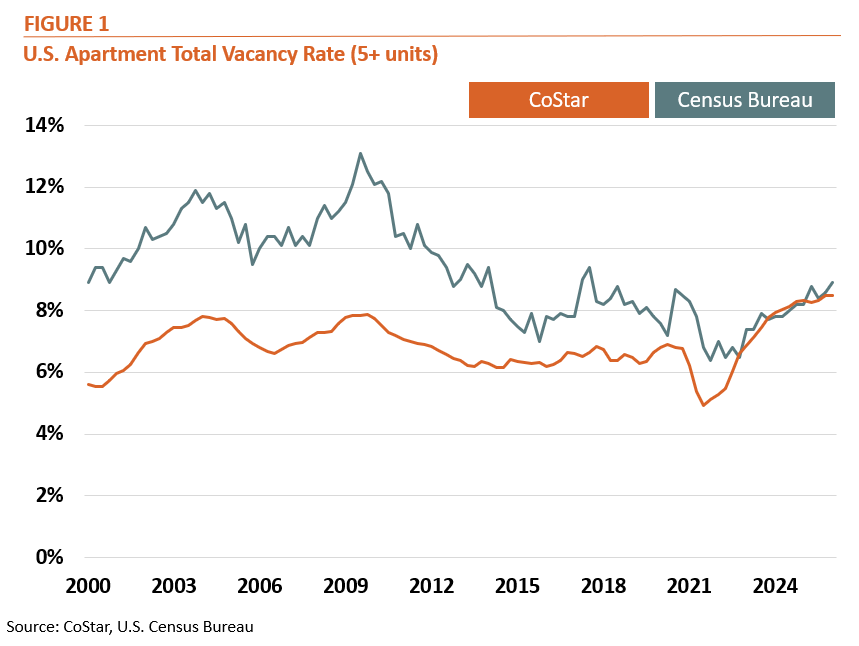
The U.S. Census Bureau’s rental vacancy rate for all apartments (rental units in buildings with five or more units) rose 30 basis points (bps) to 8.9% in 1Q 2026, up 70 bps from the previous year and marking the highest vacancy since 2017. CoStar’s total vacancy rate stayed flat at 8.5%, up 17 bps from 1Q 2025. CoStar data have shown vacancy rates steadily rising since 3Q 2021.
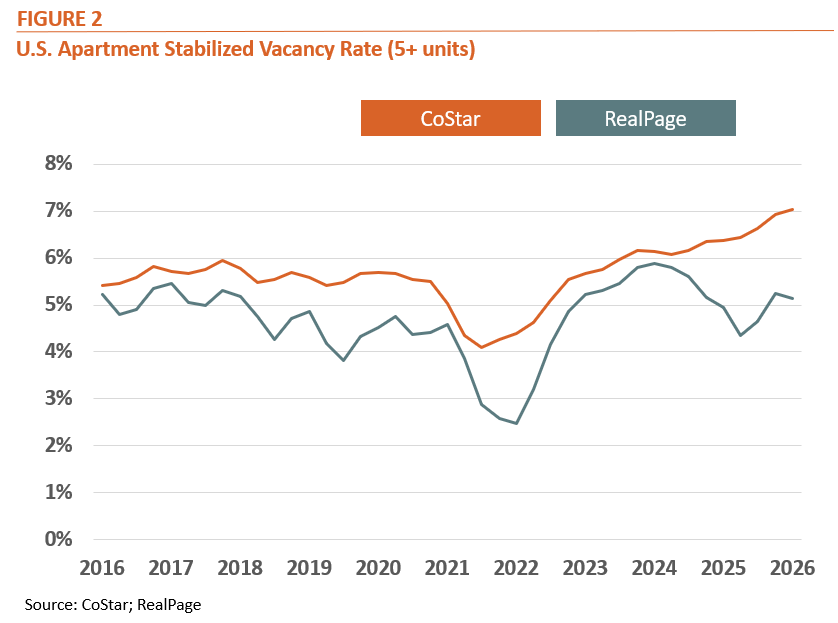
CoStar’s stabilized vacancy rate, which excludes newly built apartments, rose by 12 bps to 7.0% in the first quarter, up 66 bps from 1Q 2025. Yet, the stabilized vacancy rate reported by RealPage, which tacks professionally managed apartments, actually edged down by a slight 11 bps to 5.1% in the first quarter, although this still marks an increase from the 5.0% vacancy recorded a year prior.
The trend in stabilized vacancy tends to differ somewhat between CoStar and RealPage data due to the companies’ unique definitions of what constitutes a “stabilized” property:
- CoStar considers a multifamily property stabilized if it has reached 90% occupancy or if it has been in operation for 18 months.
- RealPage considers a multifamily stabilized only if it is 85% occupied, regardless of how long ago it was completed.
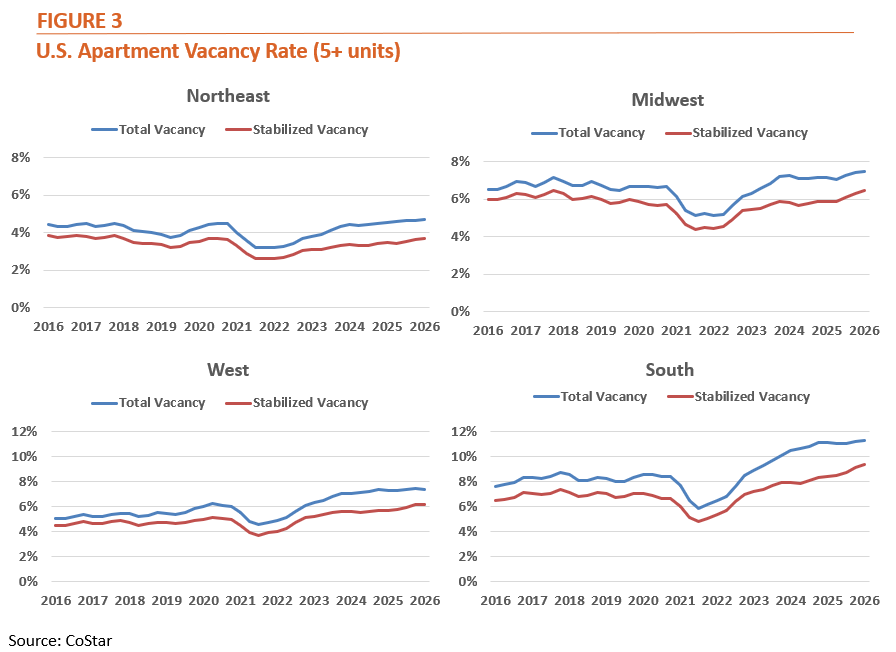
In the Northeast, the stabilized vacancy rate for apartments was up 19 bps from previous year according to RealPage and 22 bps YOY according to CoStar. Stabilized vacancy also increased year over year in the South—31 bps according to RealPage and 94 bps according to CoStar—as well as in the West (16 bps/47 bps). RealPage reported an 11 bps decrease in stabilized vacancy in the Midwest YOY, whereas CoStar data show vacancy up 59 bps.
Rent Growth Stagnates
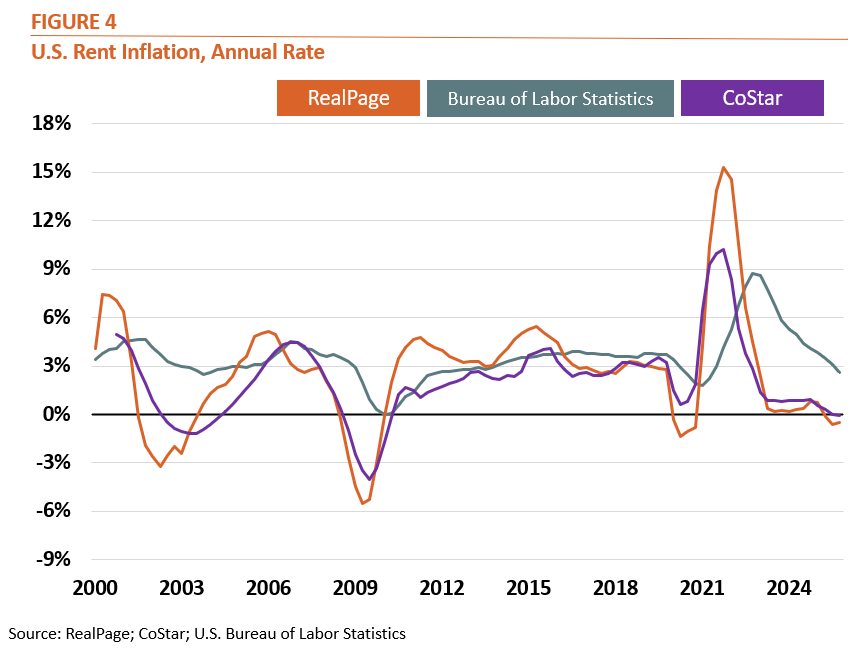
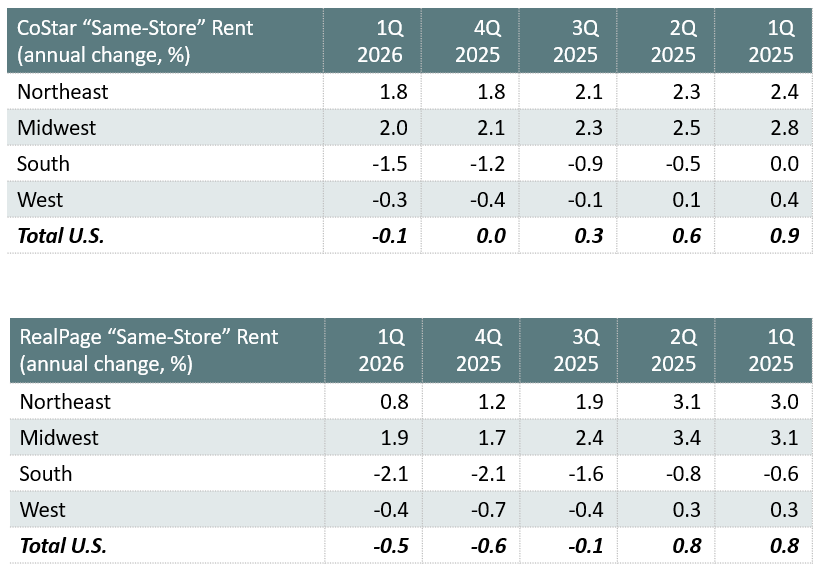
RealPage annual “same-store” rent growth (effective asking rents) stayed negative in 1Q 2026 at -0.5% YOY, a gentler but similar decline to last quarter’s -0.6% YOY. The decline was most acute in the South (-2.1% YOY) and softer in the West (-0.4% YOY), while rents continued to grow in the Midwest (1.9% YOY) and Northeast (0.8% YOY). CoStar’s measure of effective year-over-year rent growth showed slightly negative rent growth nationwide (-0.1%), with a similar regional pattern of continued growth in the Northeast (1.8% YOY) and Midwest (2.0% YOY) and declines in the South (-1.5% YOY) and West (-0.3% YOY).
Private Data Providers Show Continued Slowdown in Starts, While the Census Bureau Shows an Uptick
The U.S. Census Bureau and private data sources continue to diverge on the direction of multifamily construction.
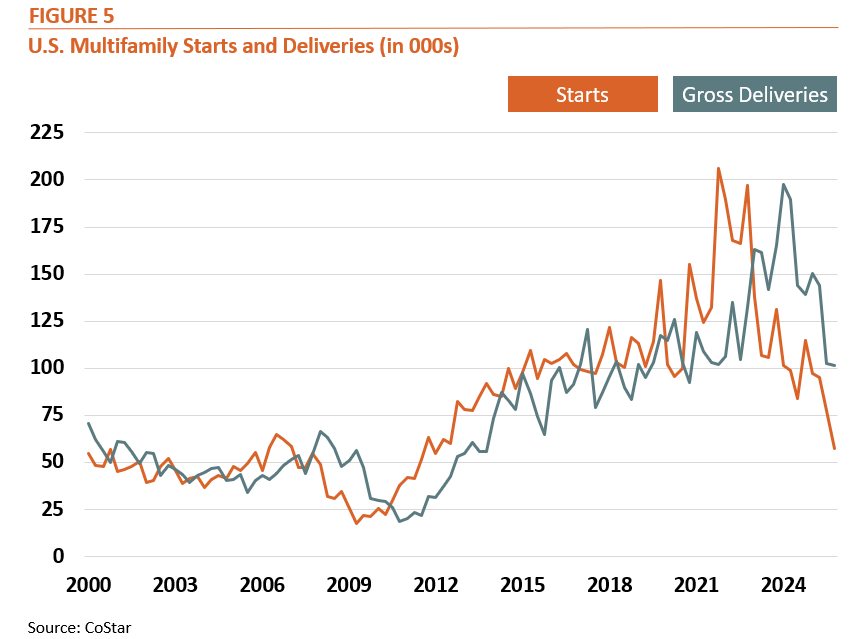
According to Census data, multifamily starts (5+) rose 17.5% in the first quarter—and 22.0% from 1Q 2025—to a seasonally adjusted annual rate (SAAR) of 443,700. CoStar data, on the other hand, show multifamily starts decreasing 25.9% from last quarter to 57,609 units, down 49.8% from 1Q 2025 and representing the lowest quarterly starts figure since 2Q 2012.
This decrease in starts spanned all regions, according to CoStar, but was most pronounced in the South, where starts were down 35.8% from last quarter and 59.1% from 1Q 2025, followed by the Midwest, where starts fell 32.4% from last quarter and 64.0% from the previous year. CoStar data also show multifamily starts decreasing 11.2% in the first quarter in the Northeast (down 24.6% from 1Q 2025) and just 0.4% in the West (down 19.5% from 1Q 2025).
Census data show multifamily completions rising 5.4% in the first quarter to a SAAR or 450,700, down 18.4% from the previous year. CoStar data, meanwhile, show multifamily completions relatively flat from last quarter (down 0.8%) and 27.0% lower than in 1Q 2025.
More specifically, multifamily completions rose 10.5% from last quarter in the Northeast and 4.8% in the South, according to CoStar, while completions fell 11.4% in the Midwest and 7.4% in the West. Year over year, however, CoStar data show multifamily completions down in all regions—33.7% in the Midwest, 29.3% in the West, 27.4% in the South, and 15.7% in the Northeast.
Multifamily Absorptions Continue to Fall on an Annual Basis
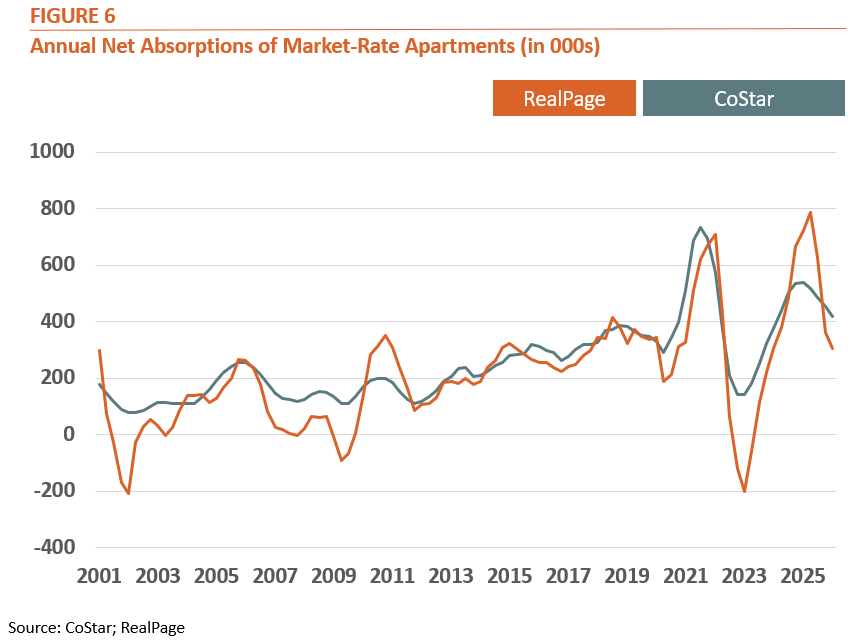
Net absorptions of investment-grade market-rate apartments tracked by RealPage stood at 93,277 in the first quarter, up from last quarter’s seasonally weak -40,379 units absorbed but marking a 37.7% decrease from 1Q 2025. On an annual basis, national absorptions fell 15.7% from last quarter—and 58.0% from 1Q 2025—to 303,377, the lowest amount in over two years.
CoStar reported 85,516 absorptions in 1Q 2026, up from last quarter’s 64,616 but down from 123,292 units absorbed in 1Q 2025. On an annual basis, CoStar absorptions fell 7.4% to 418,839 in the first quarter, down 22.4% from the previous year.
Transactions Fall, Slight Rise in Cap Rates
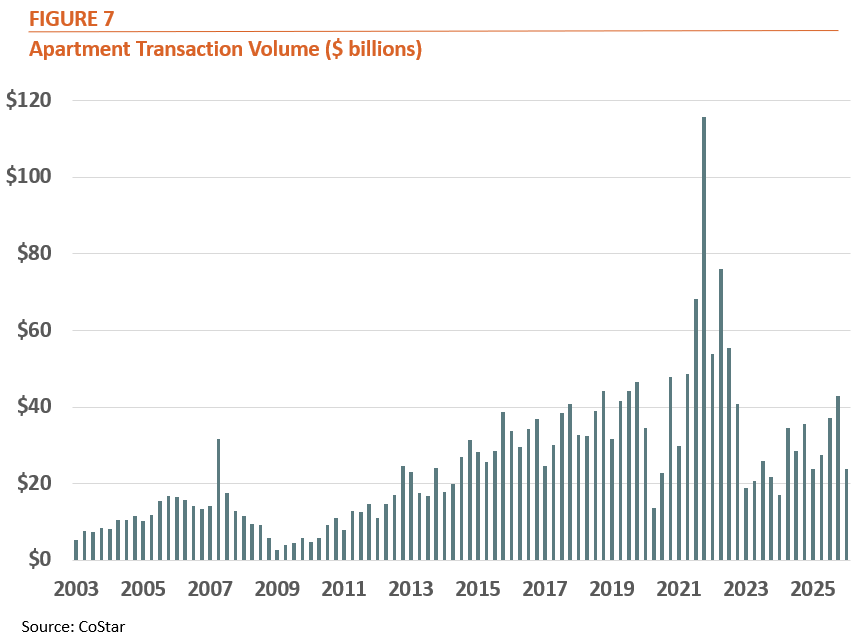
Total sales volumes reported by CoStar dropped 44.3% in 1Q 2026 to $23.8 billion, similar to the $23.8 billion recorded in 1Q 2025. Over the past four quarters (2Q 2025 through 1Q 2026), however, multifamily sales volume totaled $131.1 billion, the highest trailing four-quarter sum since 2Q 2023.
Cap rates continued to tick up slowly, rising 13 bps in the first quarter to 6.56%, according to data from CoStar, 12 bps higher than in 1Q 2025.
The market value of investment-grade apartments, as measured by the National Council of Real Estate Investment Fiduciaries (NCREIF), fell 0.2% from last quarter but was up 0.5% from 1Q 2025.
Apartment Expenses Moderate but Continue to Outpace Rents Over a Five-Year Lookback
The average expense per multifamily unit stood at $720.68 in 1Q 2026, according to data from Yardi Matrix, just 0.2% higher than a year earlier. Yet, this amounts to 28.5% higher expenses than five years prior (1Q 2021), or an average increase of 5.1% per year (annual apartment expense growth peaked at 10.4% YOY in 4Q 2022 before moderating in subsequent years).
Same-store apartment rents1, in comparison, rose just 15.2% over this five-year period (an average of 2.9% per year), according to data from CoStar, or 21.1% (an average of 3.9% per year), according to data from RealPage. In other words, apartment rents have failed to keep pace with expenses.
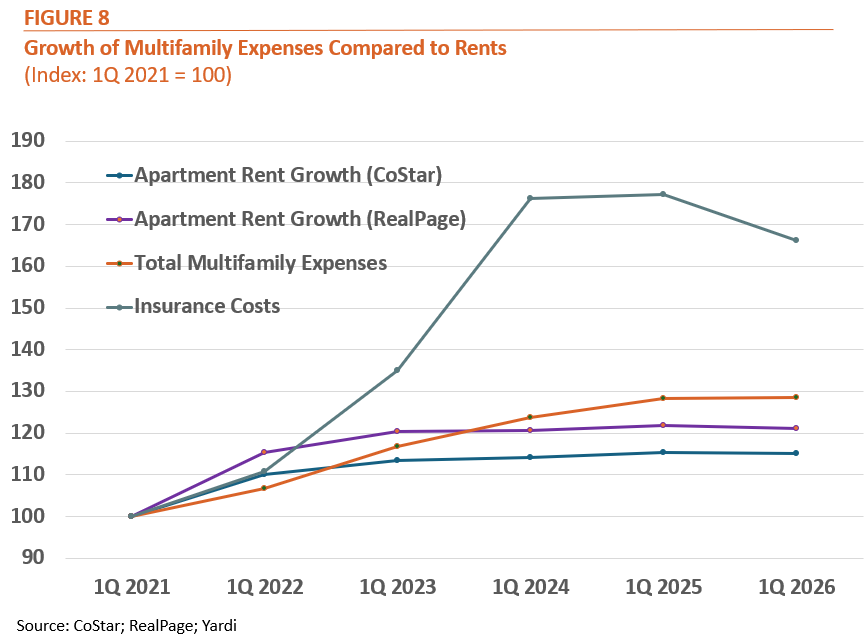
Insurance costs, even after decreasing 6.2% this past year, stood 60.2% higher in 1Q 2026 than they were five years prior, which amounts to an average increase of 10.7% per year (faster than all other line items).
Marketing and advertising expenses rose 7.1% over the past year, higher growth than all other apartment expenses (likely in effort to combat the rising apartment vacancies noted earlier in the writeup). Marketing expenses for apartments also rose by an average of 7.5% per year over the past five years, faster growth than all other expenses except insurance.
Other apartment expenses that outpaced rent growth over the past five years include administrative expenses (growing at an average rate of 6.8% annually), repairs & maintenance (6.2%) and utilities (5.7%), according to Yardi.
1Effective asking rents.
About Market Trends
Market Trends is a high-level quarterly summary of key trends in the industry for apartment executives. Each issue features the latest data on demand and supply trends for apartment residences, along with vacancy rate, absorption and rent trends. In addition, coverage includes an overview of the apartment transaction market with data on apartment sales volume and pricing. Each issue also contains a special analysis of an important and timely trend.
Questions & Comments
Please direct any questions or comments on this edition of Market Trends to Chris Bruen, NMHC's Senior Director of Research and Chief Economist.