




By Chris Bruen
Chris Bruen is Senior Director of Research and Chief Economist, with primary responsibility for aiding in and expanding upon NMHC’s research in housing and economics. Chris holds a bachelor’s degree in Finance from The George Washington University and an M.S. in Economics from Johns Hopkins University.
New analysis by the National Multifamily Housing Council (NMHC) finds that apartments continue to record the highest risk-adjusted returns of all commercial real estate types.
A 2018 NMHC Research Foundation study conducted by Mark J. Eppli, Ph.D. and Charles C. Tu, Ph.D. found that privately held apartments generated higher investor returns compared to other types of commercial real estate (retail, industrial and office) from 1987 to 2016, both on a nominal and risk-adjusted basis and for a range of holding periods.
More than eight years have now passed since this study was released—during which time the real estate market has experienced significant volatility from (in chronological order) the COVID-19 pandemic and corresponding recession, aggressive fiscal and monetary stimulus, elevated inflation and rapid interest rate hikes—so we wanted to examine whether our more up-to-date dataset (1987-2026) showed a change in risk-adjusted apartment returns.
While we did record a downward revision for short, one-year holding periods, more recent data actually show an increase in risk-adjusted, ex-post returns for apartment investors with longer-term, 3-, 5-, 7-, 10-, and 15-year time horizons, which were unaffected by these shorter-term market fluctuations.
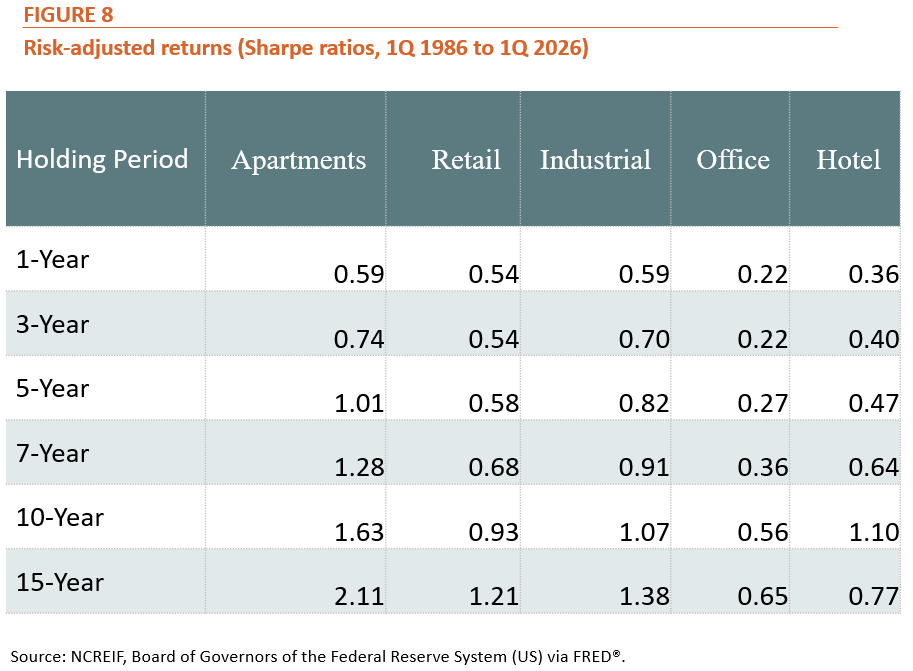
Furthermore, our more up-to-date dataset continues to show apartments outperforming all other real estate types (retail, industrial, office and hotel) on a risk-adjusted basis.
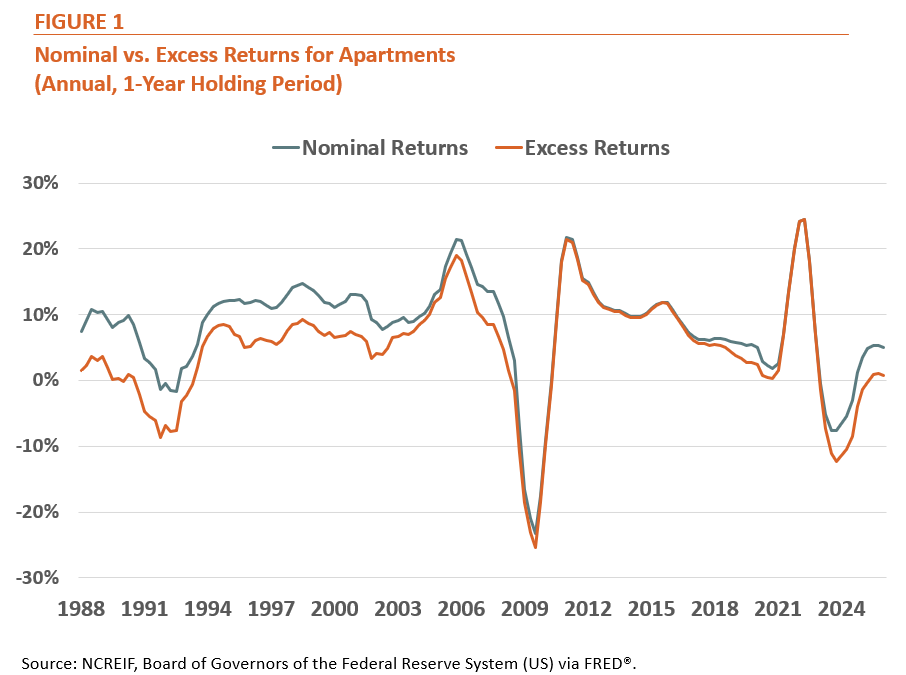
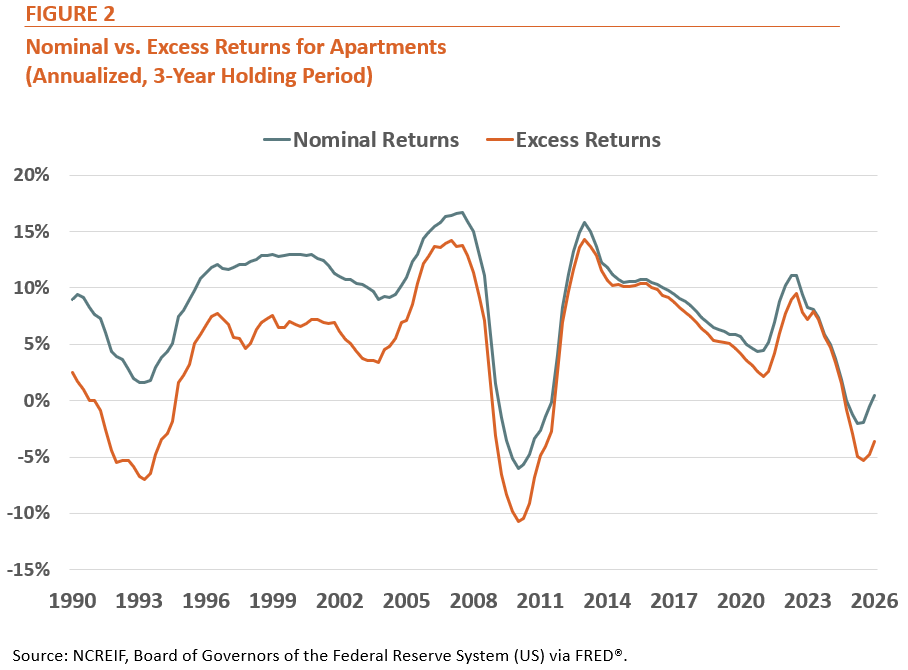
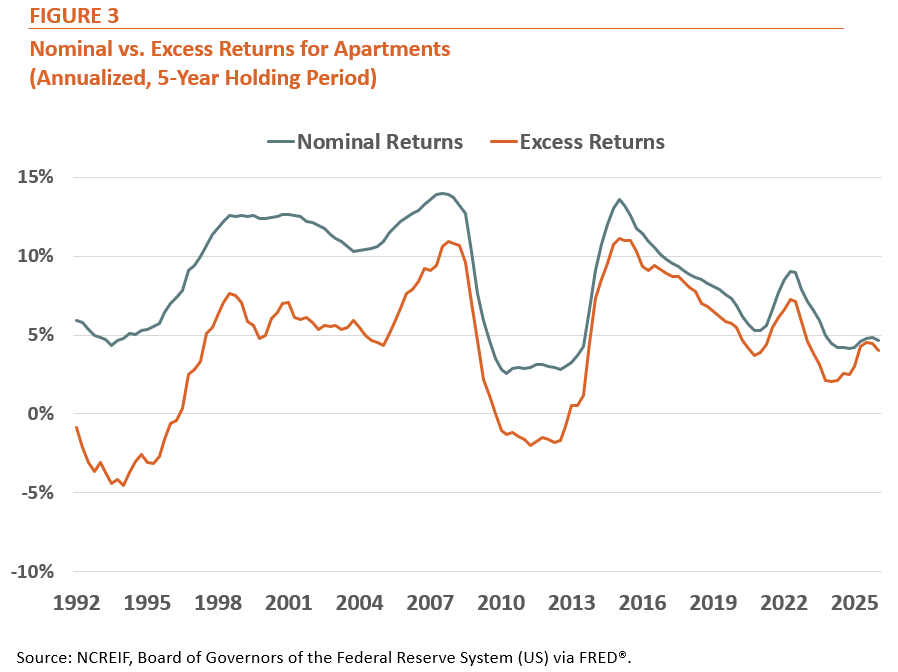
The private-apartment market returned an average of 4.8% per year from 4Q 2016 to 1Q 2026 (nominal, unlevered), according to data from NCREIF, lower than the 8.9% average observed during the preceding three decades (1Q 1987 to 4Q 2016). Yet, one reason that apartment returns were so much higher during the earlier part of this data series (the late 1980s through the early 2000s) is that interest rates were also much higher. Because Treasury Bills provide a risk-free rate of return for investors, apartments or any other “risky” asset, must entice investors with an expected excess return over and above this risk-free rate.
Figures 1 through 4 below illustrate how the gap between nominal and excess apartment returns has narrowed over time as interest rates have decreased.
 |
 |
 |
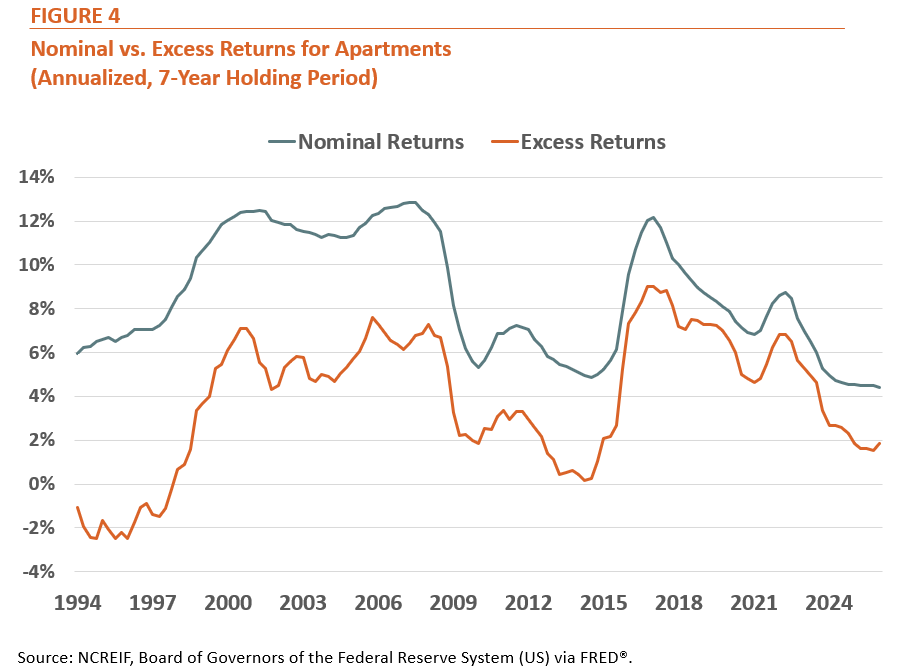 |
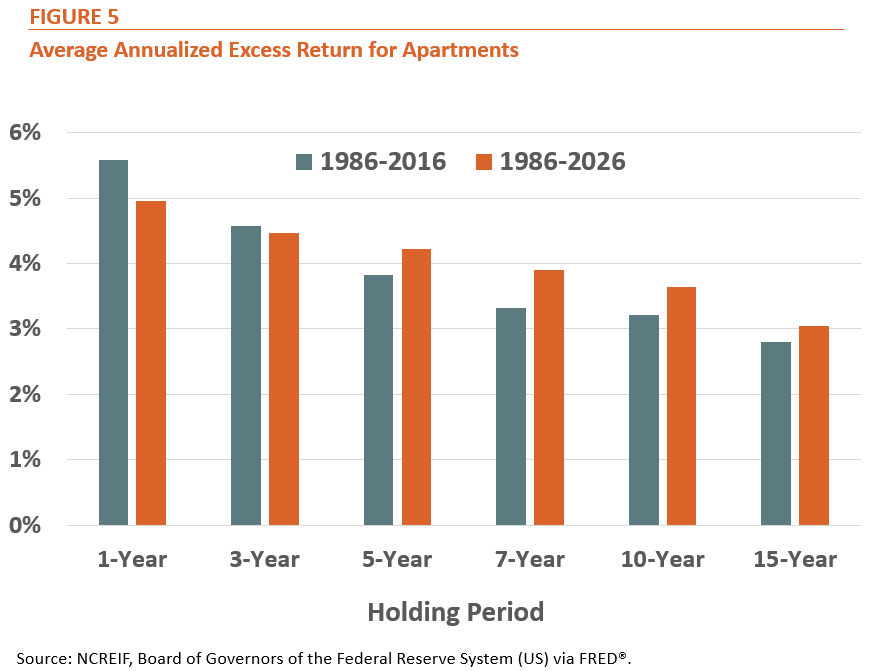
When we updated our dataset from 2016 to 2026, the average excess return for apartments became slightly lower for investors with shorter 1- and 3-year holding periods but higher for those with 5-, 7-, 10, and 15-year holding periods.
 |
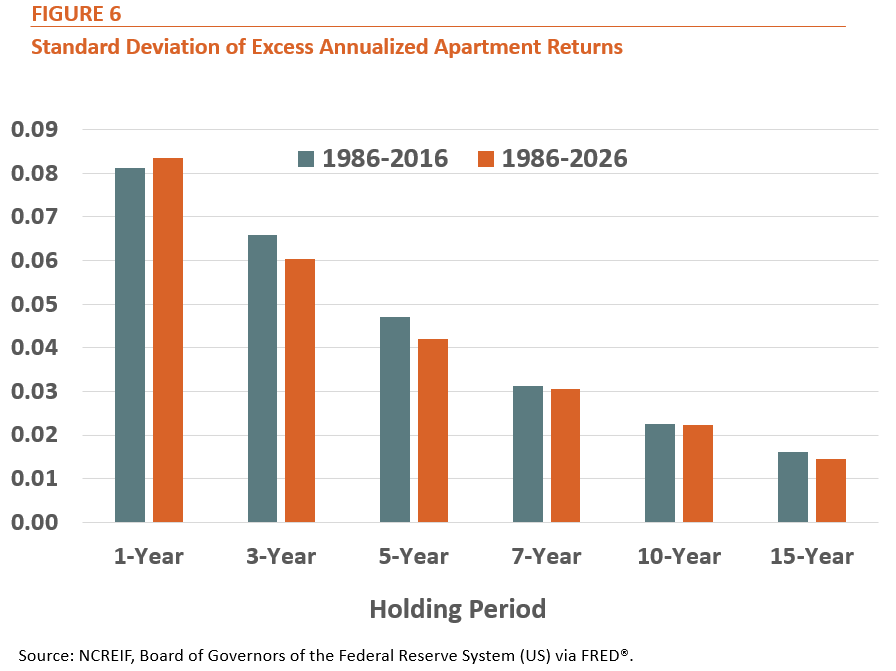 |
Apartment investors with shorter time horizons have also experienced considerable volatility since the end of 2016. Those with a one-year holding period saw returns ranging from -7.6% (for those who purchased in 3Q 2022 and sold in 2023) to +24.5% (for those who purchased in 2Q 2021). But these short-term market swings are far less impactful for longer-term investors. In fact, we found that the standard deviation of excess returns (a common measure of market volatility) actually became lower for investors with 3-, 5-, 7-, 10-, and 15-year holding periods when we updated our data from 2016 to 2026.
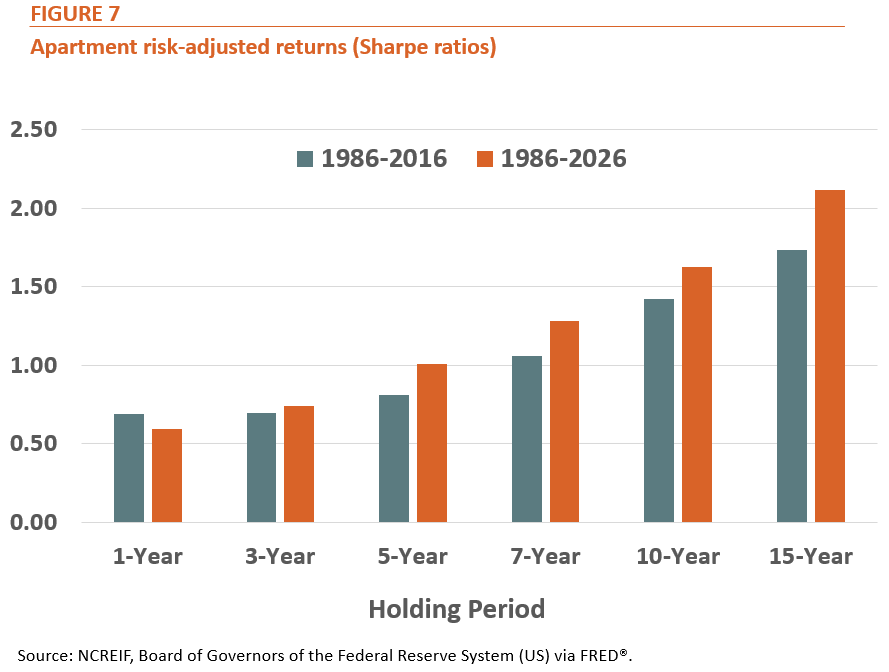
The net effect of this increase in excess returns and decrease in volatility for apartment investors with longer time horizons was an increase in risk-adjusted returns, measured by the Sharpe ratios illustrated above.1
Apartments continued to outperform other real estate types on a risk-adjusted basis
Looking at the entire updated NCREIF dataset from 1Q 1987 to 1Q 2026, apartments recorded the highest risk-adjusted returns of all commercial real estate types for all holding periods (apartments and industrial were tied for 1-year holding periods when rounded), followed by industrial, retail, hotel and office properties.
Still, as with all investments, past performance does not guarantee future returns, and current market conditions present many challenges to prospective investors. For instance, historic levels of new supply coupled with slowing job growth has yielded lower-to-negative rent growth in recent years, persistent inflationary pressure continues to keep interest rates elevated and operating costs continue to rise.
1 Calculated as the average excess apartment return—the nominal return minus a “risk-free” interest rate (measured by historical treasury rates)—divided by the standard deviation of excess returns to account for risk.
Questions or comments on Research Notes should be directed to Chris Bruen, NMHC Sr. Director of Research and Chief Economist.