




By Chris Bruen
Chris Bruen is Senior Director of Research and Chief Economist, with primary responsibility for aiding in and expanding upon NMHC’s research in housing and economics. Chris holds a bachelor’s degree in Finance from The George Washington University and an M.S. in Economics from Johns Hopkins University.
Why Absorptions are More than Just a Measure of Demand
Housing providers frequently reference absorption—the net change in the number of occupied rental homes—as a proxy for household demand. That makes sense—because stronger demand often means more people signing leases. But, that’s not the full picture. Leasing activity is also a function of new supply: When more apartments get built, rents tend to fall, which makes it easier for more people to access housing (thereby forming more households).
CoStar and RealPage data show absorptions increasing in the second quarter of this year, which one could use as evidence that household demand remains strong or has strengthened.
- CoStar data show 161,434 apartment homes being absorbed in 2Q 2026, up 50.9% from 1Q 2026 and 11.7% from a year ago.
- RealPage data show 187,212 apartment homes being absorbed in 2Q 2026, up 103.8% from 1Q 2026 while marking a 13.7% decrease from a year prior.
Yet, recent years have seen record levels of apartment completions, which has resulted in lower and even negative rent growth in many markets, incentivizing/enabling more people to lease rental homes. This Research Notes illustrates the role that historic levels of supply have had on apartment absorption numbers.
How Housing Availability Shapes Absorption
In a market with strong rental demand but very limited housing availability (few new deliveries and an extremely low vacancy rate), much of that demand is translated into higher rent growth rather than higher absorptions, since there are very few homes to be leased/absorbed. Put simply, you can’t move into a home that doesn’t exist.
San Francisco illustrates this dynamic. According to CoStar, fewer than 1,000 apartments have been delivered in the past 12 months—representing a mere 0.35% increase in the market’s inventory—the vacancy rate stands at just 3.8% and effective asking rents have increased 11.0% year-over-year. In a market with so little available inventory, strong demand is more likely to manifest through rising rents than through unusually high levels of absorption.
In contrast, in a market where household demand is relatively stable, but a large number of apartments are delivered, absorption may increase simply because there are more housing units available to lease. In these cases, housing providers lower rents to attract residents and achieve higher occupancy levels, allowing additional households to lease newly available homes.
Take Lakeland, FL, for instance. Between 2Q 2023 and 2Q 2026, Lakeland increased its supply of apartments by 37.4%, more so than any other top 150 CoStar market, resulting in a 9.7% cumulative decrease in effective asking rents. Rather than signaling a deterioration in market fundamentals, the moderation in rents reflected the market’s adjustment to a substantial increase in housing availability, providing prospective renters with more housing options and improved affordability. Over the same period, Lakeland absorbed 8,115 apartment homes from 2Q 2023 to 2Q 2026, 77.1% more than during the prior three years.
The Relationship Between Supply and Absorption
Looking across markets (see Figure 1 below), the pattern holds up: Markets that built more between 2Q 2023 and 2Q 2026 also tended to have higher levels of absorption.
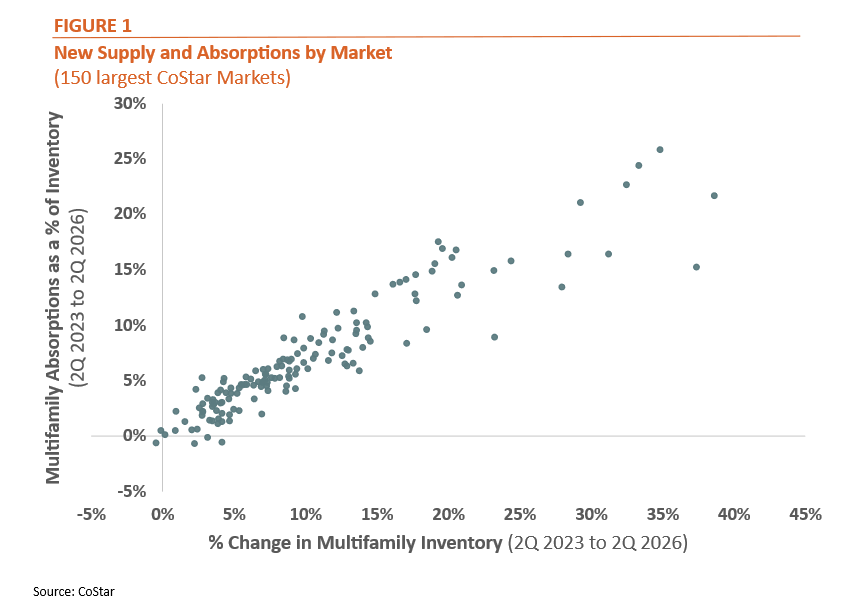
Of course, builders build new housing because they expect demand for it. But the fact remains that demand can only translate into actual move-ins (absorptions) if there are enough available apartments to move into.
Conclusion
These findings complement our earlier Research Notes, which showed that record apartment completions and the nation’s long-term housing needs are not mutually exclusive. Just as elevated construction does not eliminate the need for additional housing, rising absorption should not automatically be interpreted as evidence of stronger household demand. Rather, absorption reflects how much leasing is actually happening—which depends both on how many want to rent and how many apartments are available for them to rent. Evaluating absorption alongside deliveries, vacancy rates and rent growth provides a more complete understanding of apartment market conditions.
Questions or comments on Research Notes should be directed to Chris Bruen, NMHC Sr. Director of Research and Chief Economist.