




By Chris Bruen
Chris Bruen is Senior Director of Research and Chief Economist, with primary responsibility for aiding in and expanding upon NMHC’s research in housing and economics. Chris holds a bachelor’s degree in Finance from The George Washington University and an M.S. in Economics from Johns Hopkins University.
Key Takeaways:
- U.S. wages have outpaced both rents and consumer prices over the past six years, even after accounting for record-high rent growth in late 2021/early 2022.
- These market developments have yet to be reflected in official data on renter “cost burdens”—the share of income households pay in rent—likely due to the lag between changes in asking rents and actual rents being paid.
Housing affordability remains a pressing issue for American households, and rightfully so. Underproduction of housing in the wake of the Great Financial Crisis resulted in a growing housing shortage over the subsequent decade and a corresponding increase in costs that still lingers today.
Harvard’s Joint Center for Housing Studies reported in its 2026 edition of “America’s Rental Housing” that the share of cost-burdened renter households (those who spend more than 30% of their income on rent) remained at a record-high 49% in 2024, citing data from the American Community Survey, up 3.1 percentage points from 2019 and 8.8 percentage points from 2001.
But is the U.S. rental market really the most unaffordable it’s ever been? In the years following the COVID-19 pandemic, apartment construction ramped up to the highest levels in decades, resulting in low and even negative rent growth in many parts of the country.
Effective asking rents—what it costs to sign a new lease, including any concessions—grew 0.2% per year over the past three years (1Q 2023 to 1Q 2026) among same-store apartments tracked by CoStar and RealPage, well below the average rate of inflation during this period (2.7% per year). If we extend the analysis back an additional three years to include the record-high rent growth recorded in 2021 and 2022, effective asking rents still only grew at average rate between 2.5% and 3.1% per year during the six years from 1Q 2020 to 1Q 2026, which, again, was below the average annual rate of inflation (4.0%).
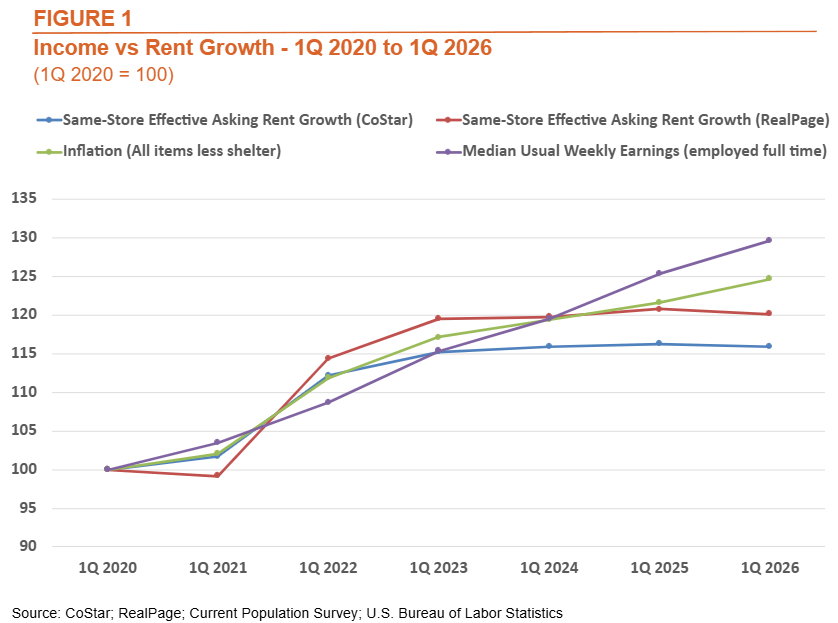
Wages, meanwhile, outpaced both rent growth and inflation during this post-COVID period, with median usual weekly earnings for full-time workers increasing by an average of 4.4% annually from 1Q 2020 to 1Q 2026, according to the Current Population Survey. Lower-income workers posted the largest gains, with first decile and first quartile usual weekly earnings increasing by 4.7% per year. The highest-income workers—those in the ninth decile—saw their earnings increase by an average of just 2.7% per year, generally keeping pace with rent growth but falling short of inflation.
The Austin metro area recorded the largest differential between income and rent growth over the past six years (4Q 2019 to 4Q 2025), with the average weekly wage increasing 40.7% (5.9% per year) and effective asking rents decreasing 3.0% (0.5% per year).1 Austin was followed by San Jose, CA (a 60.3% increase in wages versus a 10.1% increase in rents), Seattle (43.9% / 10.6%), Denver,(35.3% / 3.8%), and San Francisco (38.8% / 6.9%).
Why aren’t these trends reflected in our most recent cost-burden ratios?
Asking rents tend to be the quickest to respond to changing market conditions—providing the best reflection of current supply and demand dynamics. Rents charged for renewals follow (since not all apartment homes are immediately subject to renewal), and average rents actually being paid at any given point in time (the rent component of inflation, for instance) shift most gradually of all as residents move or renew their leases. The typical apartment resident is unaffected by changes in asking rents or renewal rents being charged in the market until their lease expires.
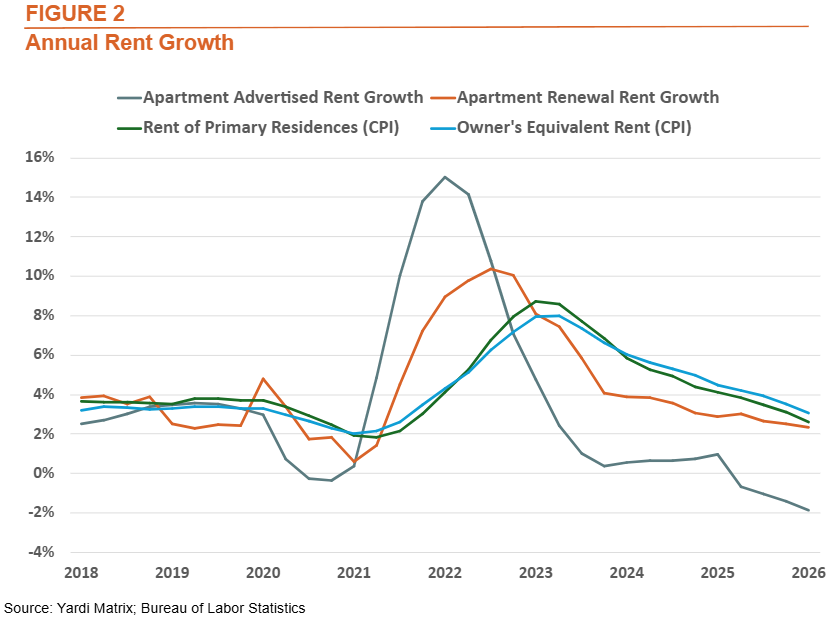
Thus, the 2024 American Community Survey, which has the most recent data on renter cost-burdens, is not only two years old at this point but also measures rent levels that lag behind more current changes in the market.
Higher retention rates or lower resident mobility could mean that it is taking longer than usual for changes in asking rents to show up in what typical renters are paying.
One important caveat to this analysis, however, is that wages outpacing rent growth is only relevant to Americans who are employed full time. Figure 3 below shows that, in 2024, apartment households without full-time employment were nearly twice as likely (1.87 times) to experience cost burdens and more than three-and-a-half times as likely (3.67 times) to experience severe cost burdens compared to apartment households with at least one adult working full time.
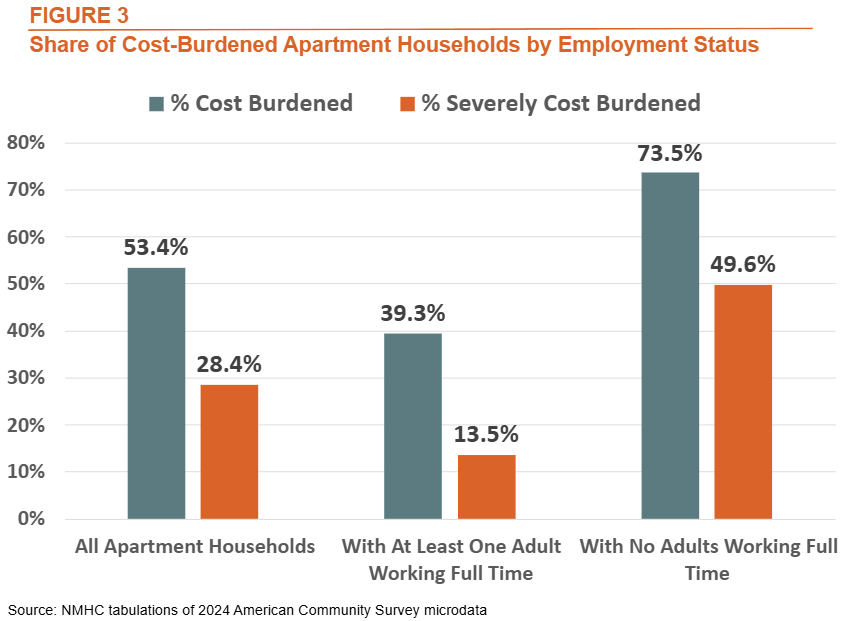
Wages have outpaced rents and inflation in recent years, but the unemployment rate has also ticked up modestly since 2024, from 3.9% in May 2024 to 4.3% in May 2026. The rate for the youngest Americans (16-24), who have traditionally been more likely to rent, remains more than twice as high, at 9.4% in May 2024.
Conclusion
Wages have outpaced the growth of apartment asking rents over the past six years, which should eventually translate to lower cost-burdens (rent as a percentage of income) for residents.
This is not to say that apartment households are not still struggling with affordability. Because the U.S. underbuilt housing for more than a decade following the Great Financial Crisis, leading to a growing shortage and increasing housing costs, this recent wave of new construction is just beginning to address our nation’s more chronic undersupply of housing.
Furthermore, apartment residents are now having to contend with rising inflation unrelated to the cost of housing. Consumer prices, excluding the cost of shelter, rose 4.7% between May 2025 and May 2026, according to the Consumer Price Index, exceeding the 3.4% rise in the cost of shelter during this period. As the shelter component of inflation continues to ease, the price of other goods and services will start to account for a larger share of household budgets.
1 According to data from CoStar and The Quarterly Census of Employment and Wages. The Quarterly Census of Employment and Wages has yet to release wage data for 1Q 2026 at the metro level.
Questions or comments on Research Notes should be directed to Chris Bruen, NMHC Sr. Director of Research and Chief Economist.