



Author

By Chris Bruen
Chris Bruen is Senior Director of Research and Chief Economist, with primary responsibility for aiding in and expanding upon NMHC's research in housing and economics. Chris holds a bachelor's degree in Finance from The George Washington University and an M.S. in Economics from Johns Hopkins University.
Despite easing considerably over the past few years, rent inflation as measured by the Consumer Price Index (CPI) continues to read significantly higher than apartment rent growth figures reported by private data providers such as CoStar, RealPage, Yardi and Zillow.
This is largely due to higher rent growth for apartment lease renewals and single-family rentals as well as the CPI’s methodology, which lags behind real-time market changes. This Research Notes examines how CPI is calculated, why it can diverge from other measures of rent growth and what these differences tell us about current apartment market conditions.
How Is CPI Calculated?
The “rent of primary residence” category accounts for around 22.0% of CPI shelter and 7.8% of the total CPI. However, survey rent data are also used to calculate "owners' equivalent rent," an estimate of what homeowners would pay to rent in their own home (if it were a rental), which makes up 73.6% of shelter and 26.2% of overall CPI. Other CPI shelter categories include “lodging away from home” and “tenants’ and household insurance.”
The rent of primary residence index is based on a survey of just around 48,000 rental housing units. Furthermore, the change in this index for any given month uses data from just one-sixth of that sample (about 8,000 sampled units). Responses from the monthly survey are compared to those from the same rental units six months earlier, and roughly one-sixth of that observed change is applied to arrive at the month-over-month change in rents.
This methodology, based on a small number of survey responses weighted to be representative all urban U.S. housing units, differs from that employed by private data providers in the multifamily sector, which aggregate unit-weighted statistics from data collected for millions of apartment homes nationwide.
Breaking Down Different Rent Measures
CPI rent of primary residence rose approximately 2.9% between October 2025 and October 2026, according to the October CPI report, marking the eighth consecutive month in which rents rose at a slower pace than non-shelter consumer prices.1 This also represents a significant 5.9 percentage-point deceleration from the peak of 8.8% annual rent inflation recorded in April of 2023.
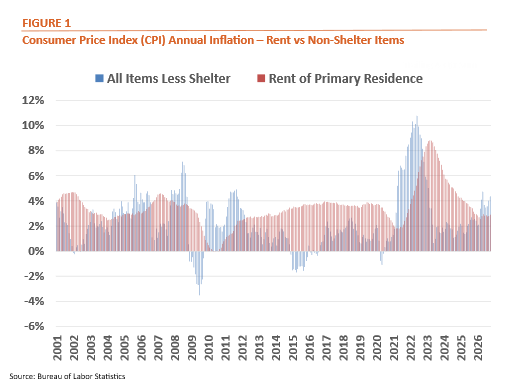
Still, 2.9% annual rent inflation may seem high considering that effective asking rents rose just 0.9% YOY among same-store apartments tracked by both CoStar and RealPage during that same period. This discrepancy comes down to three main factors:
1) Rent growth for renewals is currently higher than for new leases
Data providers such as CoStar, RealPage and Yardi typically report either changes in asking rents—or what it costs to sign a new lease—or effective asking rents, which incorporate concessions offered to new leases. Asking rents tend to be more responsive to changes in market conditions and, thus, are generally more volatile than rents offered to residents seeking to renew their lease.
When apartment asking rents tracked by Yardi Matrix decreased in 2020 during COVID, renewal rent growth remained positive; when apartment asking rents rose more than 15.0% YOY in 2022, renewal rent growth peaked at a much lower 10.5%; and when asking rents rose by an average of just 0.2% per year between 3Q 2022 and 3Q 2026, renewal rent growth averaged 3.4% annually.
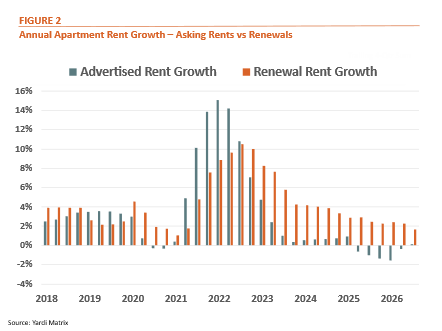
While renewal rents for apartments tracked by Yardi Matrix rose just 1.7% YOY in 3Q 2026—down 59 basis points (bps) from the second quarter and 81 bps from a year earlier—this is still much higher than the corresponding 0.1% annual increase in asking rents in the third quarter.
2) Rent growth for apartments is currently lower than for single-family rentals
It’s also important to remember that the rent of primary residence series reported in the Consumer Price Index incorporates rents for both multifamily and single-family rental homes, the latter of which have recorded higher rent growth in recent years.
The Zillow Observed Rent Index (ZORI) found that rents among single-family homes rose by an average of 3.2% per year over the past three years, considerably higher than the 1.8% average rent growth recorded for multifamily.
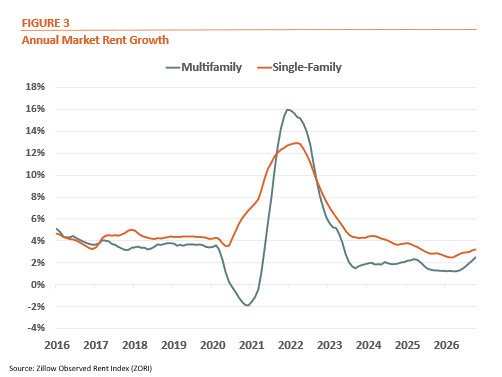
Because approximately 38% of the sample used to calculate the rent of primary residence index consists of single-family homes, this measure of rent inflation should be higher than the rate of multifamily rent growth.
3) There’s a lag between changes in market rents and what’s picked up in CPI
Changes in market rents—both for renewals and for new leases—don’t actually affect renters until their lease (typically one year) expires. For this reason, changes in the rent component of inflation typically lag behind changes in asking rents or renewal rents.
For instance, growth in effective asking rents reached a low of -1.4% YOY in 3Q 2020 among apartments tracked by RealPage and 0.0% YOY in 4Q 2020 among apartments tracked by CoStar. Yet CPI rent of primary residence didn’t reach its bottom until April of 2021, at 1.8% YOY.
Similarly, while effective asking rent growth peaked in 1Q 2022 among apartments tracked by RealPage (15.3% YOY) and 4Q 2021 among apartments tracked by CoStar (10.5% YOY), rent inflation didn’t peak until April 2023, at 8.8% YOY.
What Can We Expect from CPI Rent Going Forward?
Is the CPI measure of rent ever going to perfectly match private data providers? No. Effective asking rents among a set of “same-store” apartments have been effectively flat over the past four years, which should translate to lower renewal rent growth and ultimately, lower CPI rent inflation over the coming years. But because CPI rent includes lease renewals and single-family rentals, both of which are seeing faster rent growth, and lags behind changes in market rents, we should expect it to differ from asking rent growth reported by housing providers for the foreseeable future.
For housing providers and policymakers, these distinctions underscore the importance of considering multiple measures of rent growth as well as understanding the underlying data inputs. While CPI rent provides an important measure of changes in housing costs experienced by renters over time, it does not necessarily reflect current conditions in the apartment market.
1 Since there was no CPI report for October 2025 during the government shutdown, we took the average between the September and November observations.