



Authors

By Caitlin Sugrue Walter, Ph.D.
Caitlin Sugrue Walter, Ph.D. is SVP and Head of Research and Innovation, with primary responsibility for overseeing NMHC's research efforts. Caitlin holds a B.A. and B.S. from Rutgers University and a Ph.D. in Planning, Governance and Globalization from Virginia Tech.

By Chris Bruen
Chris Bruen is Senior Director of Research and Chief Economist, with primary responsibility for aiding in and expanding upon NMHC's research in housing and economics. Chris holds a bachelor's degree in Finance from The George Washington University and an M.S. in Economics from Johns Hopkins University.
Why Vacancy and Rent Trends Don't Tell the Whole Housing Story
The U.S. continues to face a long-term housing shortage despite a recent wave of new apartment deliveries, combined with slower population and job growth, that has left some metro areas with elevated vacancies and declining rents.
Understanding how both can be true at the same time is important as policymakers consider proposals intended to encourage the next generation of housing production and housing providers assess future apartment demand given these complicated operating conditions. This Research Notes examines these dynamics and considers how the recently enacted 21st Century ROAD to Housing Act could help address longer-term housing needs even as the apartment market works through current supply and demand imbalances in some markets.
Understanding What the National Housing Shortage Really Measures
Freddie Mac and the Brookings Institution estimates published in 2024 indicate that the U.S. needs to build between 3.7 and 4.9 million additional homes, encompassing the full housing market, spanning single-family and multifamily, for-sale and for-rent¹.
At first glance, it may be difficult to reconcile this idea of a shortage of apartments given current market conditions are characterized by rising vacancy rates and flat-to-decreasing rents at the aggregated national level:
- The total vacancy rate for apartments tracked by CoStar stood at 8.1% in the second quarter of 2026, 3.2 percentage points higher than the record-low recorded in the third quarter of 2021.
- Effective asking rents (what it costs to sign a new lease) rose just 0.6% over the past three years among apartments tracked by CoStar, failing to keep pace with a 9.8% increase in consumer prices (consumer price index).
But housing shortage estimates are not just simply the number of vacant units compared to the number of households. Stating that there is a shortage does not mean that every available apartment should be occupied today. That distinction may be difficult to square with the very real challenges facing housing providers in markets where elevated vacancies, concessions and declining rents are affecting property operations. Those near-term conditions, however, measure something different from the longer-term housing need captured by shortage estimates.
Housing shortage estimates from Freddie Mac and Brookings account for “latent demand”, or individuals who would form households if housing costs were not as high, which can be significant even in a market experiencing decreasing rents in the short run.
In other words, the need for housing is not fully captured by the number of people currently looking for an apartment or house. Some people may be living with parents, sharing housing with roommates or otherwise delaying forming their own household because housing costs are too high.
This underlying need can remain significant even when rents are temporarily declining in a particular market—rents are declining but still may not be at a price affordable for a great number of people to be able to rent a unit on their own given wage growth, job opportunities and other factors in a given market.
For example, rising housing costs have contributed to a growing share of young adults (18-34) living with their parents over the past few decades (from 27.7% in 2000 to 33.0% in 2025, according to the U.S. Census Bureau). As housing becomes more attainable, some of these individuals may choose to establish households of their own, creating demand that is not necessarily visible in today’s vacancy or rent-growth figures.
Furthermore, even though historic levels of deliveries have translated to lower-to-negative rent growth in recent years, this spike in new supply will likely be short lived. The rapid increase in interest rates in 2022, coupled with lower rent growth, resulted in a 50.0% decrease in annual multifamily starts² over the last 3 years (2Q 2023 to 2Q 2026), according to data from CoStar.
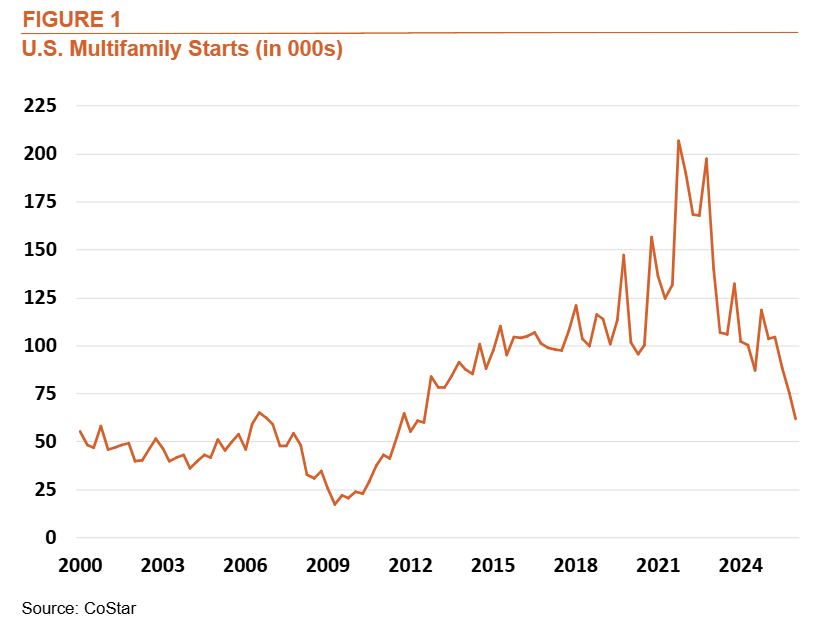
As it can take multiple years to complete and lease up a multifamily property, despite the historic deliveries over the last few years, we anticipate this significant reduction in new construction activity for an extended period of time to cause many markets to continue to tighten moving forward. This too is an indicator of a long-term national housing shortage, despite the temporary supply boost in some communities.
Metro Area Performance Indicates the Benefit of New Construction
Notably, national housing shortage estimates can obscure a wide degree of variation across markets. A national shortage does not mean that every metro is undersupplied to the same degree at every point in time. Rather, it reflects an aggregate gap between the local housing stock and the number of homes needed to accommodate existing households and those that would have formed if there were enough housing at a price point to create more household formation.
Local conditions depend heavily on how much housing has been built, where it has been built and how quickly demand has grown. Figure 1 below illustrates a point made in prior Research Notes—that markets with higher rates of multifamily deliveries in recent years (largely in the South) have tended to experience lower (and often negative) rent growth.
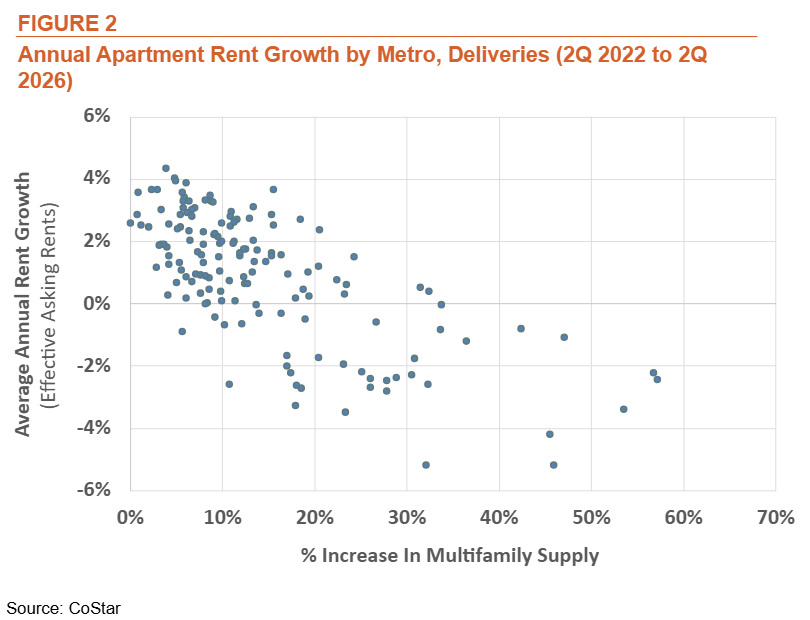
Austin, TX, provides a particularly clear example of how new construction can change those conditions. Following several years of historically high apartment construction and deliveries, Austin’s apartment vacancy rate has risen to 9.8%, and rents have fallen a cumulative 19.2% over the past four years. In the near term, that level of construction has moved Austin from a highly constrained market to one in which renters have considerably more options and properties are competing more intensely for residents.
San Francisco illustrates a very different scenario. With substantially less new housing production, its apartment vacancy rate stands at just 3.6%—slightly over one-third of Austin’s—and rents are increasing faster than any other metros. San Francisco also has had one of the nation’s longest standing and most restrictive rent control regimes which has added uncertainty and severely constrained the ability of developers to finance desperately needed new apartments. These contrasting experiences illustrate an important distinction: some individual markets may have added more apartments than near-term demand could immediately absorb, but that does not mean the nation as a whole has built too much housing.
Austin also demonstrates what happens when housing production is able to respond quickly to demand: vacancy increases, renters gain negotiating power and rents adjust. Those outcomes may be challenging for housing providers in the near term, but they are also the mechanism through which additional housing improves affordability and allows new households to gradually form.
New Supply is Not the Only Driver of Market Performance
A primary driver of this variation in market performance in recent years has obviously been added housing supply, but new construction alone does not explain rent growth or decline in some metros.
The Washington, DC, metro area has built fewer apartments than the national average over the past four years, according to CoStar, but effective asking rents fell 2.5% between 2Q 2025 and 2Q 2026. The metro has also recorded a 2.6% decrease in total employment between 2Q 2025 and 2Q 2026, the biggest decrease of any top-150 CoStar market. Recent changes to the laws governing the relationship between housing providers and residents have made DC an increasingly difficult operating environment which is also playing a role in investor and developer decision-making.
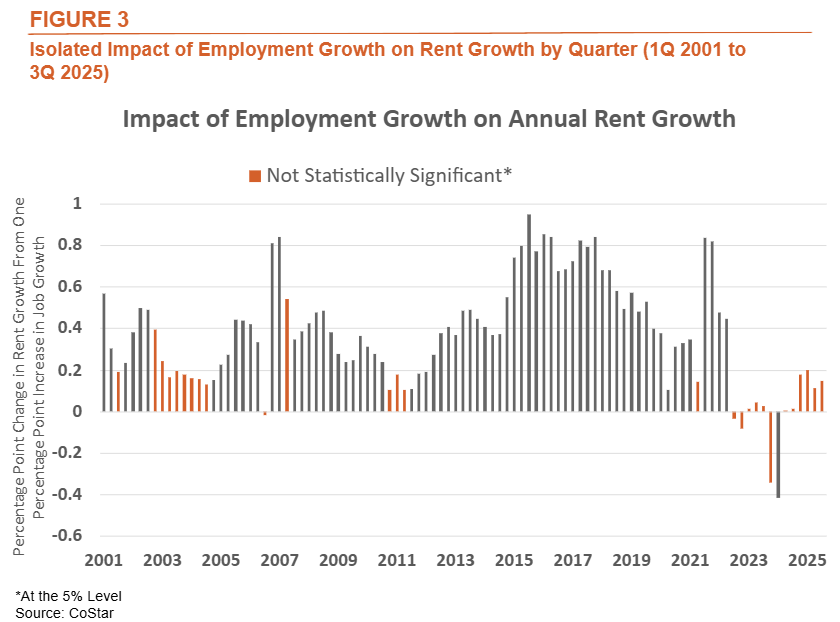
This is not a phenomenon unique to D.C. either—total U.S. employment expanded by just 0.2% over the past year (July 2025 to July 2026), according to data from the Current Employment Statistics Survey, the lowest rate since the COVID-19 pandemic in 2020. This recent slowdown in national job growth is likely exacerbating the downward impact that temporary high levels of new supply are having on rent growth in the apartment market.
Current apartment performance reflects both sides of the equation. Recent historically high deliveries have increased the number of available apartments in some markets while slower job growth, lower immigration and changing migration patterns have weakened demand. Together, these trends help explain why apartment market conditions have softened more than new supply alone would suggest—and why today’s elevated vacancies in certain markets should be viewed in the context of both unusually high deliveries and weaker-than-expected demand.
The Role of Government-Subsidized Rental Assistance and Affordable Housing
This increasingly complicated relationship between multifamily supply and demand in some markets also underscores that building more market-rate housing, while necessary, cannot address every dimension of housing affordability. While increasing the nation’s housing supply is critical, a previous Research Notes analysis revealed that a large share of cost-burdened renters will never be able to afford market-rate housing on their own, regardless how much housing is built, simply because they do not earn enough to cover housing costs. In these cases, some sort of financial assistance or government subsidy is needed.
NMHC’s recently released Housing Affordability Toolkit examines this group in greater detail and evaluates the extent to which existing programs and policy tools can address their housing needs going forward. Under current programs and production levels, the toolkit estimates that it would take decades to meet the housing needs of the nation’s lowest-income renters. At the current pace, reaching all 10.1 million severely cost-burdened, very-low-income, unassisted renter households through income assistance would take approximately 43 years, while producing enough Low-Income Housing Tax Credit (LIHTC) units to address the needs of all 22.4 million rent-burdened households would take approximately 125 years.
The timeline varies substantially across metro areas. According to the toolkit’s “time-to-address” metric, Raleigh-Cary, NC and Charlotte-Concord-Gastonia, NC-SC are currently on pace to close their housing supply deficits in just two generations (45 years) through building subsidized affordable housing, faster than all other metro areas studied. Other metros that are on pace to close their supply deficit in just two generations include Cleveland, OH (49 years), Salt Lake City, UT (50), and Buffalo, NY (52).
What sets these metro areas apart from the pack, the toolkit notes, is a combination of:
- Low-to-moderate construction costs—most notably, in Buffalo and the entire state of North Carolina—which makes both market-rate and affordable housing development more feasible;
- Local subsidies layered on top of federal programs;
- Streamlined entitlement and zoning reforms—notably, in Utah and Salt Lake City specifically; and
- “Capital A”/Subsidized affordable housing production—by definition, these are metros that have just generally made it a priority to build more subsidized affordable housing.
Metros that are estimated to take more than a century to address their housing deficits through subsidized development—include St. Louis, MO (956 years), Kansas City, MO (630), and Birmingham, AL (526).
How Much Will The 21st Century ROAD to Housing Act Help?
The recently enacted 21st Century ROAD to Housing Act represents a bipartisan effort to address the nation’s housing affordability challenges by advancing policies intended to support both market-rate and subsidized affordable housing. Many of these efforts were designed to help ease regulations, which NMHC and NAHB research has found comprise an average of 40.6% of total development cost for new apartments.
Among other provisions, the law aims to streamline environmental reviews, provide incentives for localities that adopt pro-housing reforms and expand financing opportunities for affordable housing development and preservation.
While these reforms have the potential to reduce barriers to housing production and help drive down the cost of development attributable to regulations, their impacts will take time to materialize. Implementation timelines vary considerably across provisions, and many will depend on subsequent federal rulemaking and appropriations.
The enactment of this law is certainly a positive development toward making housing more affordable, but it is also important to remember that this new legislation comes at a time of challenging market conditions. Specifically, the combination of an economically challenging environment for housing operators and persistently high interest rates makes new development difficult to pencil out. According to data from CoStar, there were only 579,344 multifamily units under construction as of the second quarter of 2026, 19.5% fewer than in the previous year and the lowest amount since 4Q 2015.
Reconciling Competing Interests
The apartment market has delivered a historic amount of housing in the last 2 years, but this is an unusual snapshot in time, resulting in some markets where supply has temporarily outpaced demand. For apartment owners and operators in those markets, elevated vacancies, declining rents and increased concessions are creating significant operating and financial pressures as properties compete to attract and retain residents. Given the dramatically reduced construction starts in the last 3 years, indications are that this situation is temporary.
Yet as challenging as these conditions are, they also demonstrate that when sufficient housing is available, rents can adjust and affordability can improve through normal market dynamics, without policies that artificially constrain rents or otherwise interfere with the market’s ability to respond. These conditions do not mean the nation has permanently solved its housing shortage, but rather, they underscore the importance of policies that enable housing production so that supply can respond to changing needs over time.
1 Drilling down, the apartment sector represents one segment of that overall need. Research conducted for NMHC and NAA several years ago estimated that 4.3 million new apartments would need to be built by 2035 to meet future household growth (3.7 million) and a then-existing shortage of 600,000 units. Demographic conditions have changed since that analysis was conducted—most notably immigration and population growth—and today’s estimate of future apartment demand would likely be lower. But that does not mean the underlying housing imbalance has disappeared. Rather, it reinforces the importance of distinguishing between a point-in-time forecast of apartment demand and the longer-term need for a housing market capable of responding to household formation and population growth.
2 4-quarter trailing.
Questions or comments on Research Notes should be directed to Chris Bruen, NMHC Sr. Director of Research and Chief Economist.