



Authors

By Caitlin Sugrue Walter, Ph.D.
Caitlin Sugrue Walter, Ph.D. is SVP and Head of Research and Innovation, with primary responsibility for overseeing NMHC's research efforts. Caitlin holds a B.A. and B.S. from Rutgers University and a Ph.D. in Planning, Governance and Globalization from Virginia Tech.

By Chris Bruen
Chris Bruen is Senior Director of Research and Chief Economist, with primary responsibility for aiding in and expanding upon NMHC's research in housing and economics. Chris holds a bachelor's degree in Finance from The George Washington University and an M.S. in Economics from Johns Hopkins University.
An updated look at how property values, tax rates and local tax policy shape the costs housing providers face across the country.
Key Takeaways:
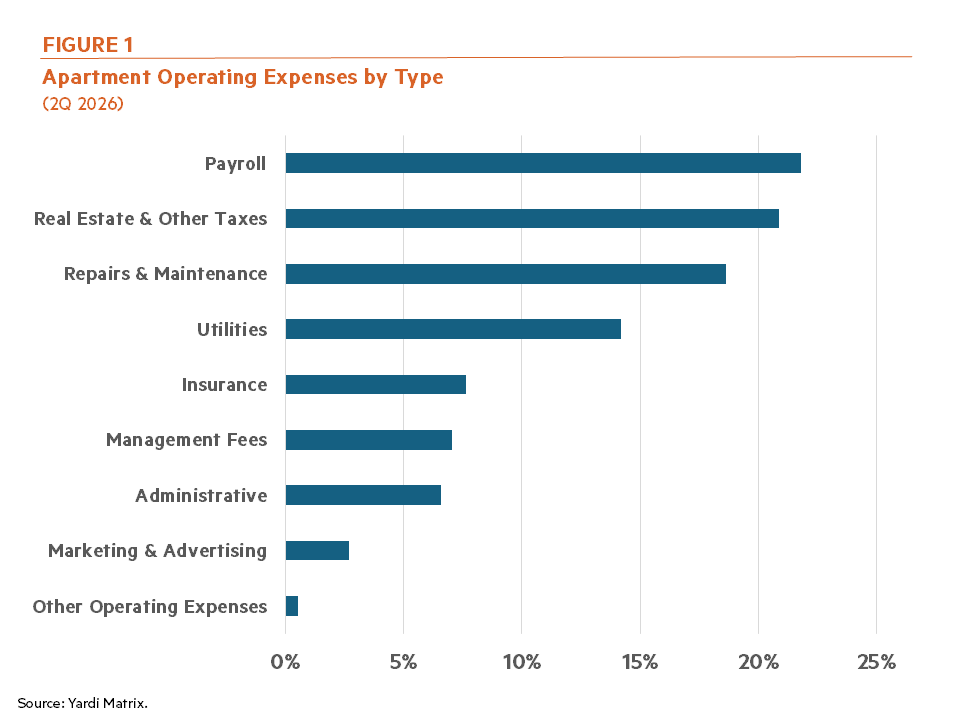
- Real estate taxes remain one of the largest operating expenses for apartments, accounting for 20.9% of total operating expenses in 2Q 2026, according to Yardi Matrix.
- Apartment real estate taxes are shaped by both property values and tax rates, which vary widely by location. In 2025, effective tax rates for apartments in each state’s largest city ranged from 3.70% in Detroit to 0.33% in Honolulu, according to data from the Lincoln Institute of Land Policy.
- Apartments often carry a heavier tax burden than homes. The Lincoln Institute of Land Policy found that in 2025, housing providers faced an effective tax rate on average 46% higher than the rate on the median owner-occupied house, the highest ratio since 2008.
Real estate taxes are one of the most significant operating expenses housing providers face, while also providing an important source of revenue for local services such as schools and fire departments. How these taxes are structured, however, varies tremendously by jurisdiction and even within states. In today’s environment of rising operating costs and shifting property values, those differences can have a meaningful impact on apartment communities. Understanding what housing providers pay—and the factors driving those tax bills—is therefore an important part of understanding the broader cost pressures facing rental housing today.
A previous Research Notes examined variation in effective property tax rates across metropolitan areas and found that apartments frequently face higher effective tax rates than owner-occupied houses, with substantial variation across markets. Building on that analysis, this Research Notes provides an updated overview of the apartment property tax landscape, including how recent changes to the various inputs to property tax calculations have impacted housing providers.
How Much More or Less Are Housing Providers Paying in Real Estate Taxes?
Broadly speaking, real estate tax bills are determined by a basic calculation:
| (Assessed value of the property) × (tax rate for apartment class) |
Data from Yardi Matrix show that real estate taxes were the second-largest operating expense for apartments in 2Q 2026, representing more than a fifth (20.9%) of total operating expenses (see Figure 1 below), just behind payroll expenses (21.8% of the total) and ahead of repairs and maintenance (18.6%).
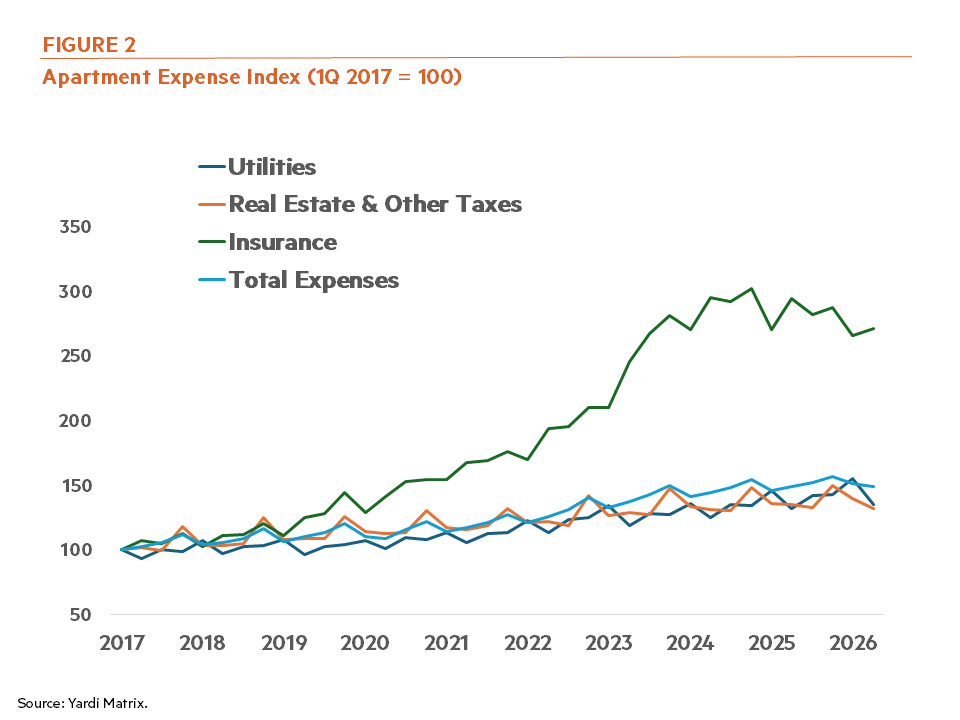
Real estate taxes have long been one of the largest expenses associated with operating an apartment community (often the largest), even as other costs have grown rapidly in recent years. Insurance costs, for example, rose 152.6% on a per-unit basis between 2Q 2017 and 2Q 2026, according to data from Yardi Matrix—the largest increase among operating expense categories (see Figure 2). Yardi data show that real estate taxes, however, increased 29.6% during the same period. More recently, from 2Q 2021 to 2Q 2026, real estate taxes per apartment unit increased 13.8%.
What is driving the increase in real estate taxes? Because there are two inputs—the tax rate and the value of the community—an increase in taxes does not necessarily mean that tax rates themselves have increased. Tax bills can also rise as apartment values increase, and those higher values are reflected in assessments. Conversely, changes in tax rates, assessment practices, exemptions and other features of local property tax systems can affect tax bills even when underlying property values change relatively little. Understanding the increase in apartment real estate taxes, therefore, requires examining both property values and tax rates, as well as how the relationship between the two varies across jurisdictions.
How Have Property Values Changed?
Property values have fluctuated in recent years, reflecting shifts in market activity and a limited number of sales transactions. Figure 3 below shows the appreciation of apartment property values from 4Q 2016 to 2Q 2026 as measured by the NCREIF Property Index. Nationally, property values increased just 1.8% between 2Q 2019 and 2Q 2026, and 6.9% since 2Q 2016. Yet within those periods, values changed significantly from year to year. Values rose 20.1% from 2Q 2021 to 2Q 2022, but the following year, values fell 8.7%.
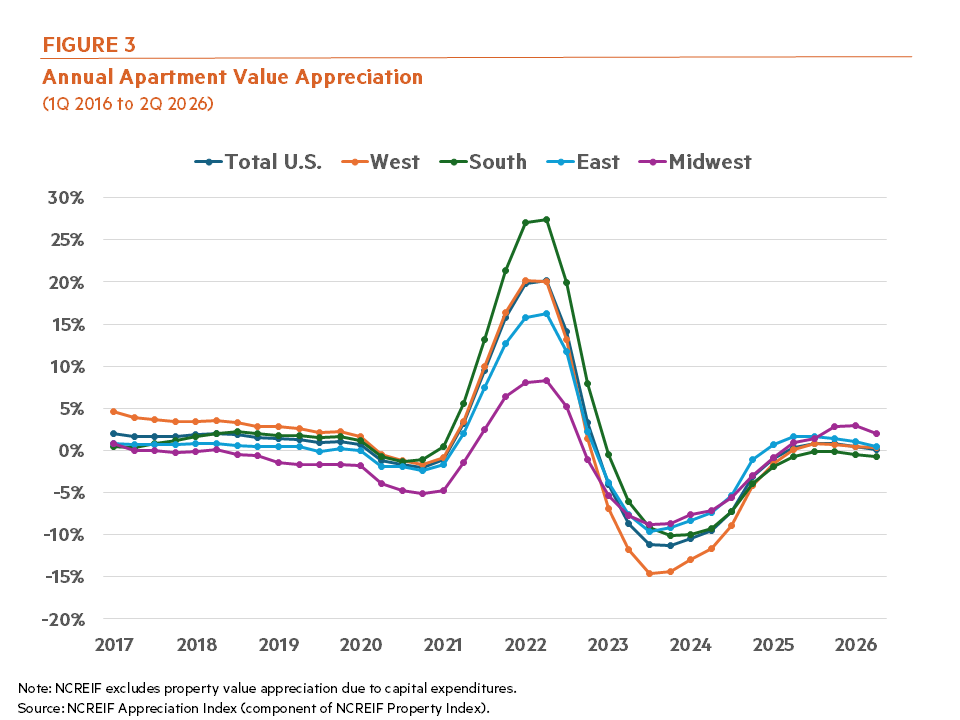
The Southern region has led the U.S. in apartment property value appreciation over the past seven years, with values rising 12.2% from 2Q 2019 to 2Q 2026, followed by the East, where values rose 1.8%. Meanwhile, apartment property values actually fell 3.2% in the West and 9.4% in the Midwest over the same seven-year period.
Looking at Assessments or Rates in Isolation Does Not Tell Us Much
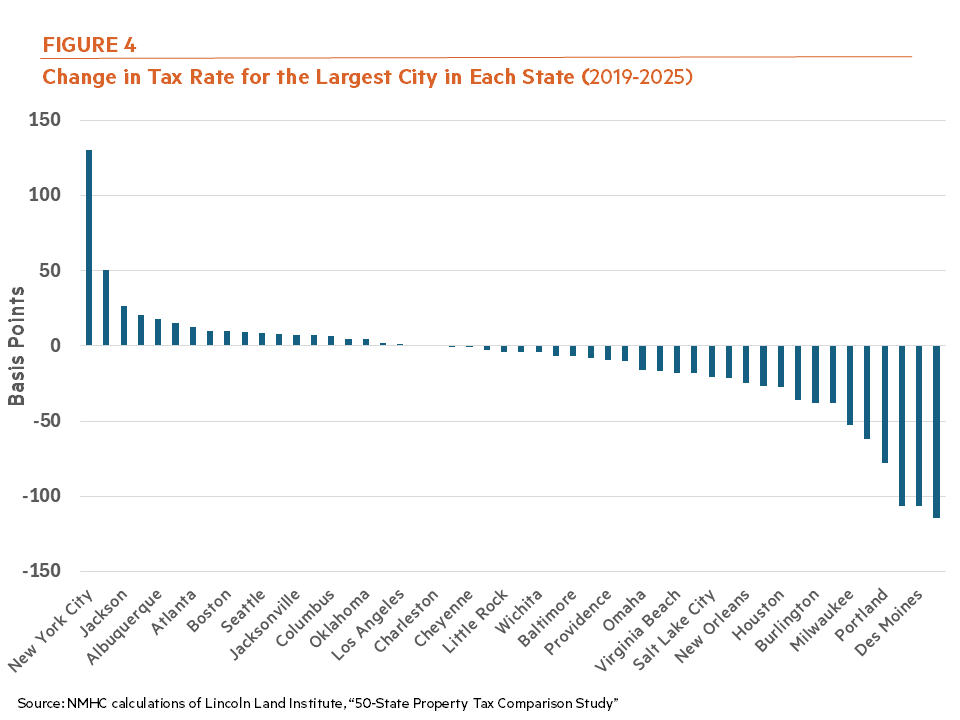
With the variation in property values, the other half of the equation is the tax rate. The Lincoln Institute of Land Policy's annual “50-State Property Tax Comparison Study” provides a look at how much a hypothetical apartment, with a property value and fixtures cost held constant, would pay in property taxes in the largest jurisdiction in each state. These effective property tax rates in 2025 ranged from 3.70% in Detroit, MI, to 0.33% in Honolulu, HI. Over time, property tax rates have changed tremendously but with little consistency (see Figure 4). Denver, CO, for example, saw an 18-basis-point decrease in the apartment property tax rate from 2019 to 2025 (0.642% to 0.459%), while Wilmington, DE, saw a 51-basis-point increase over the same period. Neither represents the extreme. Those belong to Bridgeport, CT (-1.15 percentage points), and New York City (+1.30 percentage points).
Within states and metro areas, tax rates vary tremendously as well—apartment communities in Aurora, IL, a suburb of Chicago, faced a tax rate of 2.813% in 2025, while apartment communities in Chicago itself were taxed at a rate of 1.437%. In New York City, apartments were taxed at 2.488%, compared with 1.170% in Buffalo.
Apartments versus Owner-Occupied Homes
As our earlier Research Notes found, apartments often face effective tax rates that are higher than those paid by owner-occupied housing units. In other words, relative to property value, apartment owners often bear a higher property tax burden than homeowners. The most recent Lincoln Institute of Land Policy “apartment-homestead classification ratio” finds that housing providers in 2025 faced an effective tax rate for their apartment communities that was on average 46% higher than the rate on the median owner-occupied house, which is the highest ratio since 2008. The reason for this premium varies by jurisdiction—in some cases, it is because homesteads (owner-occupied housing) are given tax exemptions, while in others it is due to a difference in assessment ratios or tax rates.
Apartment communities may also avail themselves of tax exemptions, often in the form of tax abatements. In this respect, tax abatements are not altogether different from existing homestead exemptions: both reduce the property tax burden that would otherwise apply in order to advance a public policy objective. While tax exemptions are a common way to relieve costs for homeowners, they are far less common for apartment communities, even though they are a key tool for lowering costs and advancing rental housing affordability.
What Higher Property Taxes Mean for Apartment Operations and Housing Affordability
Property taxes are a significant and highly variable part of the overall operating costs for apartment communities. With operating costs going up across the board, any changes in real estate taxes—even relatively modest ones—can have a meaningful impact on the financial viability of apartment communities.
As policymakers at all levels of government focus on housing affordability, property taxes are an important part of that broader discussion. Rental housing communities already face a significant property tax burden, and even incremental increases can contribute to higher housing costs. Understanding the relationship between property taxes and housing affordability should therefore be an important part of broader policy discussions about the cost of housing.
Questions or comments on Research Notes should be directed to Chris Bruen, NMHC Sr. Director of Research and Chief Economist.